
A man heavily adorned with blackout tattoos has shared an important lesson after experiencing firsthand the consequences of disrupting a healing tattoo too soon. The resulting damage isn’t always something that can be undone.
Dave Chudley began his blackout tattoo journey in 2020 and has since achieved extensive coverage on his body. His ultimate goal is to have up to 80 percent of his body inked in this style.
This tattooing style has surged in popularity, attracting celebrities like Kat Von D, Machine Gun Kelly, and Chris Daughtry. However, Dave embarked on his blackout journey well before it became widely recognized. Blackout tattooing involves covering large skin areas entirely in black ink, often blending with or concealing pre-existing tattoos to create a bold, consistent appearance.
Some people choose to incorporate additional artwork on top of the blackout, creating a distinctive visual effect.
Dave emphasizes that the tattoo process is only part of the equation. According to him, the distinction between an impressive blackout tattoo and one that is flawed largely hinges on the aftercare. He serves as a testament to what can go awry if proper discipline is neglected during the healing process.
Dave insists that there is one crucial rule when it comes to healing: refrain from touching the tattoo, no matter how tempting it may be. “You do not want to pick it, you do not want to touch it,” he advises. He recounted developing a scab on his neck after accidentally bumping it, yet he resisted the urge to interfere. “Don’t touch it. Otherwise, you can scar, you can get infected, and it won’t heal as well.”
He highlights the importance of aftercare, stating that even with perfect technique and saturation, without proper care, the tattoo can end up looking subpar.
“You can have great saturation, your skin can be very well saturated, it could be done exactly how it should be, and if you don’t look after it properly, you don’t take care of it, it will still heal badly and it will still end up not looking good.”
Dave also warns against overapplying healing products, stressing that the skin needs to recover naturally. “You don’t want to over apply healing products as well, you just want to kind of let it do it itself naturally.”
He shares that the typical aftercare method for fresh tattoos, such as using a second skin patch, is ineffective for blackout tattoos. “You can’t heal it like a regular tattoo. A second skin, for example, doesn’t work, because there’s just way too much fluid, plasma, excess ink that’s seeping through. So it’s just not going to work.”
As an alternative, he uses an unconventional method for tattoo aftercare. “That’s why I use puppy training pads, because they just absorb everything in. They’re large, so you can wrap them around quite well, and you just keep replacing those. That seems to be what I found the best way for healing.”
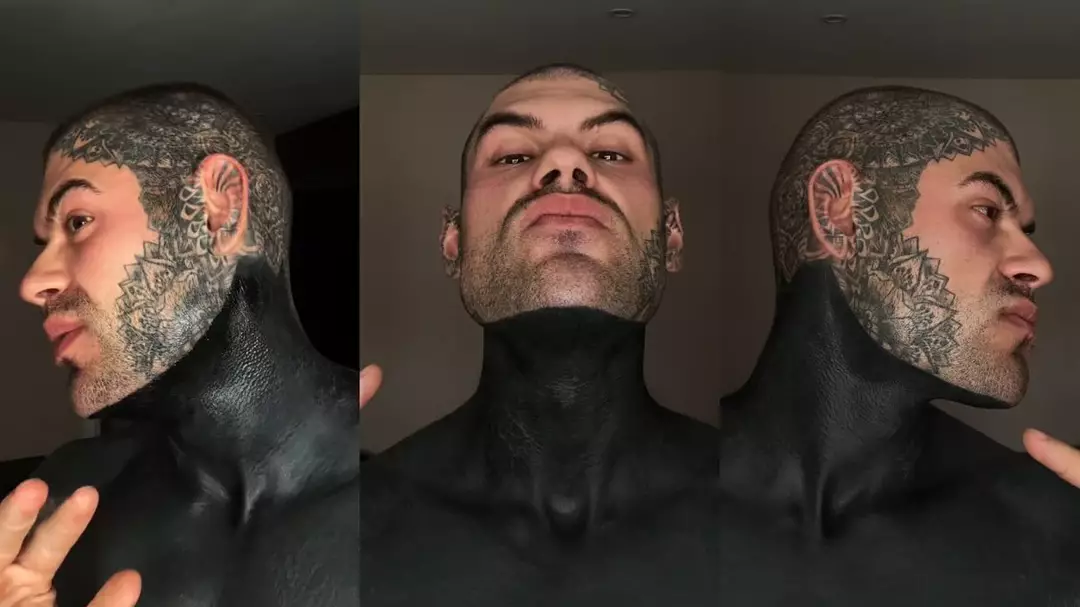
Dave highlights a common misconception that blackout tattoos are simpler because they involve “just” solid color rather than intricate artwork. He clarifies that it’s not just about filling in color but also about avoiding skin damage during the process and achieving a smooth, complete saturation.
His initial attempt taught him this lesson. He started with his forearm in 2020, only to find it didn’t align with the rest of his tattoos once healed, leading him to remove it entirely and begin anew.
Instead of enduring long tattoo sessions, Dave opts for small, regular appointments, which he finds more manageable for both pain and healing.
“My process with black work is little and often. I actually sit weekly. I find that healing is better, I find that you tolerate it better, and you can actually kind of still live your life normally while having that work done.”
He notes that the pain from blackout tattoos is distinct from standard tattoos, initially feeling rough and intensifying as the area swells. More sensitive areas like the throat or jaw are painful regardless of the tattooing style.